


Enabling landless families to acquire lots of their own
Recognizing the huge benefits to communities of its two housing projects that arose out of previous destructive typhoons, the Episcopal Church in the Philippines, through its E-CARE Foundation, has adopted as a major program the acquisition of lots by economically challenged families. This is in line with the dream of millions of people for asset reform in a country where much of its real assets are in the hands of wealthy corporations and families while the vast majority of its citizens remain landless.
It is now becoming a practice especially in the Visayas Missionary Diocese (VMD) that when the Church purchases a land for its institutional purposes, part of such land is offered to landless families to be paid in affordable installments over a certain period of time. This was recently done in Lonoy, Capiz where the ECP purchased a property for the establishment of the Krus na Banal Church as well as a rectory and multi-purpose center. A portion consisting of 1,000 square meters was awarded to ten family members of the Lonoy Oysters Association, an E-CARE partner. At the VMD strategic planning workshop on June 18, 2025 where the program was reported, one of the women partners was in tears as she expressed gratitude for the program which now allows her family to own a residential lot, an opportunity that would never have come to them considering the high cost and the fact that rarely will a seller, unless it is a developer, sell land in small cuts.
Part of the payment for the awarded residential lots came from the Banquet Fund and since the said lots will be paid in installment by the awardees, their payments will sup

Building resilient communities through
bamboo plantations
In 2004, based on the climatological analysis of weather bureau Pag-asa, around 230 millimeters (mm) of rain was expected for the month of September that year. However, on the first day of the month, which was also declared by Churches as the World Day of Prayer for Creation, a typhoon entered the Philippines and dumped the entire projected rainfall volume for the month in only 18 hours. The typhoon caused landslides and flooded 60 percent of local government units in the country, causing the death of 11 persons.
Responding to this very sad event and as part of its continuing program on creation care, the Episcopal Church in the Philippines, through the E-Care Foundation, crafted a project towards building resilient communities that focused on: (a) rain harvesting facilities to minimize rainwater concentration and use rainwater for productive purposes that should flow into the ground to replenish groundwater and recharge aquifers instead of being directed towards waterways that overflow and cause flooding, (b) bamboo propagation to beef up areas that are prone to landslides and erosion and thus are crucial in protecting slopes, farmlands, riverbanks and other waterways, and (c) solarization to reduce carbon emissions.
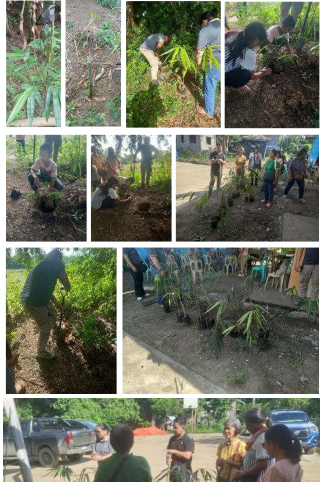
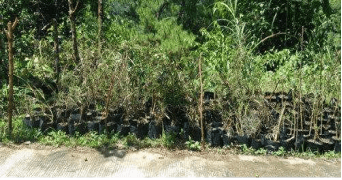
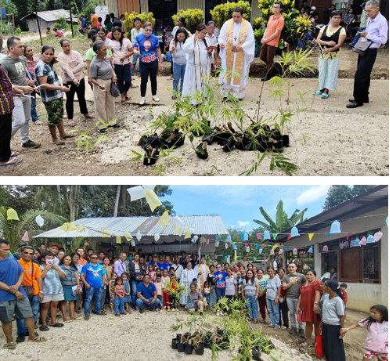
Bamboo planting is now a major focus of E-CARE’s creation care program not only because they are a cheaper and effective way to combat soil saturation, slope instability and landslides that are causing deaths and destruction mountainous regions and flooding in the lowlands but also because these can be a sustainable and profitable source of livelihood. As one specialist says, “the bamboo is the technology of the future” as it can be used to make from kitchen utensils to garments, buildings and even cars. While providing economic opportunities, the establishment of bamboo industries is one answer to the plastics crisis that is now engulfing communities.
Here is a summary report on what has been done since November 2024 towards bamboo propagation.

Arung, Bugnay; Mission Compound, Bontoc; Guina-ang, Bontoc; Bilig, Lubon,
Tadian; and Abatan, Bauko.

Shifting to Solar-powered Water Pumps
Agriculture comes with many challenges. For small-scale farmers in the municipality of Panay, province of Capiz, ensuring water supply to their rice farms especially during dry months costs them around Php 15,000 per cropping for diesel to operate a submersible water pump that draws water from a well into the farms. This cost is on top of the usual expenses for seeds, inputs, additional labor, etc. the total of which usually barely allows them to break even at harvest time. Every innovation that reduces costs is therefore always worth exploring.
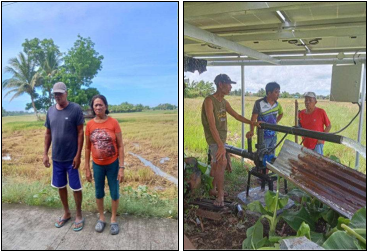
Three members of the Calapawan Rice and Vegetable Farmers Association (CARVEFA) of Panau, Capiz have done away with diesel costs when they installed a solar-powered submersible pump. Of the benefits of this pump, the three farmers say (as translated into English),
“Now that we have this submersible solar water pump we would like to share with you the advantages of having it. We are no longer burdened of lifting the diesel water pump motor every time we need to water our farms. With this new technology, we just switch it “on” and “off”. Our expenses were reduced as we no longer have to hire people to operate the motor pump. We no longer have to buy diesel.” Aside from these benefits, the farmers have done away with carbon emissions from the use of diesel. The first three participants of this solarization project are expected to gradually pass on the costs of the solar pump to other members of the association.
CARVEFA is a new partner of the E-CARE Foundation. Its members started engagement with the Foundation in August 2023 and by December of the same year, they received Php 145,000 in farm support. Granting this back in December 2024, they availed of Php 350,000 for the same purpose as additional members joined.
The solarization project is part of E-CARE’s program of building resilient communities by adopting technologies and practices that are not only environmentally-friendly but which allows them to operate at lesser financial burden. It is funded by the Banquet Fund and the Anglicans in Development (AID) of the Anglican Board of Mission – Australia.
Rainwater harvesting addresses water scarcity in EDSP
The Philippines is blessed with abundant rainfall due to its tropical climate and location. This abundance of rain is a key factor in the country’s fertile soil and agricultural productivity. With climate change, however, the country is now facing more frequent and intense extreme rainfall events that have become destructive. Heavy downpours case flooding and landslides that have resulted in death and destruction of property. This is aggravated by the current practice of gathering rain water from rooftops into gutters and spouts and directing them to canals or sewage systems which overflow and worsen flooding. This practice also reduces the distribution of groundwater that recharge aquifers.
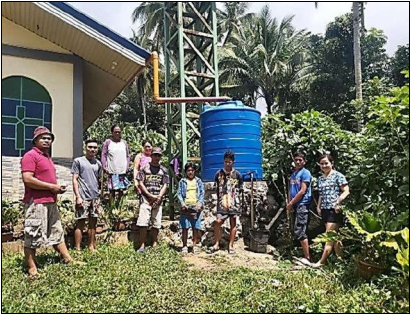
Hence, rain water harvesting to reduce water concentration and abate flooding and landslides has become a major focus of E-CARE’s development work. In the Diocese of Southern Philippines, however, rain water harvesting has become a much welcome project to address water scarcity in many communities. Barangay Lalab in the Municipality of Dimataling, Province of Zamboanga del Sur does not have a reliable potable water system and the only source is a considerable distance away which people have to walk in order to fetch water. The installation of rainwater harvesting facility at Sto Nino Church is regarded as a blessing as it is more accessible to the community.
GIVERS TO THE BANQUET FUND
Givers as of 30 June 2025
The Banquet Fund was established by the ECP as one program where people can live out the parable of the great banquet in Luke 14:7-14, where the Lord Jesus Christ said that “when you give a banquet, don’t invite your relatives or rich neighbors as they will invite you back and you will be repaid. Instead, invite the poor, the crippled, the lame and the blind and those who cannot repay you and you will be blessed!”
People who host celebrations or banquets and cannot fully obey this commandment may give to this Fund which supports those whose livelihoods are devastated by disasters. The establishment of this Fund in late 2019 was timely as it aptly responded to the covid-19 crisis. Consistent with the E-CARE Foundation’s policy that it does not simply give charity or relief assistance that may help people for a meal or two but creates opportunities for affected communities and households to rise up from devastation, the Banquet Fund partners will grant back what they received when they are able so that the said funds will also be passed on to others who are in the same or worse situation and thus enhance the spiral of sharing from one community or household to another under what is known in the ECP as Receivers-to-Givers (R2G) Practice. Under this scheme, the Banquet Funds do not end when released to partner families but are used and then shared by one to another in the never-ending spiral of sharing. Givers to the Banquet Fund become perpetual partners of families and communities which avail of the Fund.
 The Episcopal Church in the Philippines