
PRIME BISHOP NESTOR D. POLTIC SR. VALEDICTORY ADDRESS DELIVERED AT THE EXECUTIVE COUNCIL MEETING ON 09 JULY 2025.
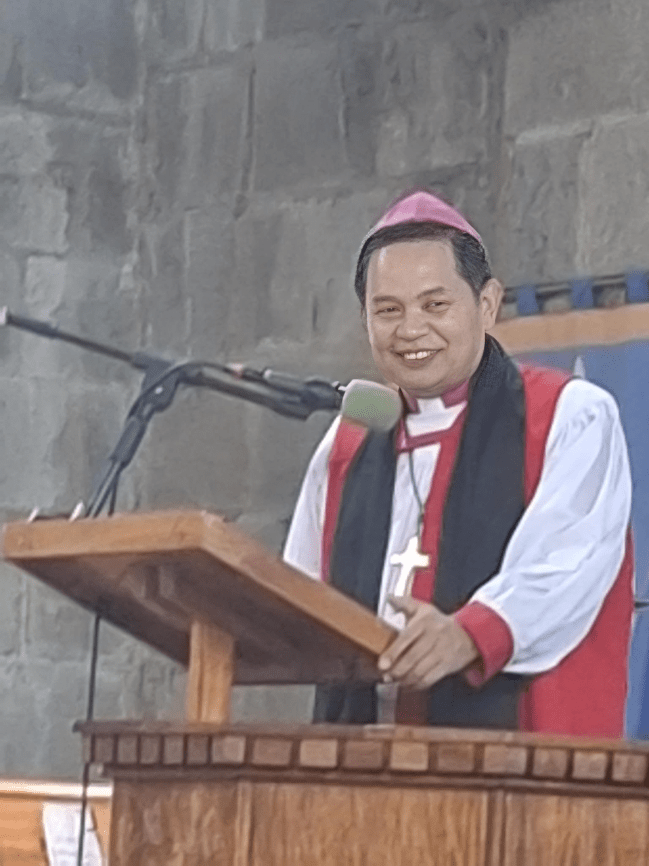
A pleasant morning to everyone! Let me begin by expressing my heartfelt gratitude to the esteemed members of the Executive Council—our hardworking national staff, devoted bishops, dedicated clergy, faithful lay members and professionals, and committed partners across our Church institutions. Your unwavering dedication and sacrifices are the foundation of the Episcopal Church in the Philippines.
I am profoundly grateful to the St. Mary the Virgin’s vestry and congregation and to their rector, Fr. Daniel Longatan, my batchmate, for graciously hosting this Executive Council meeting.
This meeting is more than just a change of scenery, but is also a conscious act of reconnection—to breathe cleaner air, to become more grounded, and to draw closer to the heart of our Church: the grassroots communities. May this setting restore not only our bodies, but our spirits as well.
Before proceeding, allow me to share a brief reflection on the passage that was read to you from Matthew 5:13–16, which has guided my preparation for this address. In these specific verses, Jesus tells His followers: “You are the salt of the earth. You are the light of the world. A city on a hill cannot be hidden… Let your light so shine before others, that they may see your good works and glorify your Father in heaven.”
Brothers and sisters, what a calling this is! Not just to believe, but to be Salt and light. Small in form, but immense in impact.
Salt preserves. It adds flavour. It prevents decay. In a world fractured by injustice, fear, conflict and greed, we—the Church—are called to bring preservation, to protect what is good, and to flavour society with grace, truth, love, and mercy.
Light reveals. Light guides. It gives hope. We are not meant to keep the light to ourselves. We are meant to shine, to reflect Christ in our actions and relationships, to be a visible testimony to God’s redeeming work in our world. And so, as we gather to deliberate, to discuss, to decide, and to dream together, let us do so not only as leaders and representatives—but as salt and light. Let this executive meeting, and our lives, reflect a Church that flavours the world with Gospel truth and shines brightly with the hope of Christ.
As this is my first meeting as your Prime Bishop and Chairperson of the Executive Council of our Church, let me commend our people and congregations for your steadfast faith and fruitful work, which has currently positioned our Church on solid foundations. The past 4 years following the COVID-19 pandemic have seen remarkable achievements, which I believe very few entities were able to do. I am glad, of course, to be proven wrong and to be informed of other churches and entities who have done exceedingly well post-pandemic. It is a sad reality, though, that over these recent years, we hear more of difficulties in recovering the losses and damages brought about by the unprecedented health challenge in the global village. In the case of the ECP, however, we have overcome our pre-pandemic situations. We have broken new ground in many areas we haven’t explored before. We are among the very few who have not only met but exceeded our financial commitments to both local and international. We have not suffered budgetary deficits but instead some surpluses even after launching new initiatives such as our Study Now Pay Later Plan for Bachelor of Theology students at Trinity University of Asia, our graduate study program for faculty and administrators of our mission schools, and on Christian Education for our clergy. We have improved our ecumenical and concordat relations, and for the first time in many decades, we have laid to rest the nuisances on joint properties that have put a strain on our concordat with the Iglesia Filipina Independiente. Not only are we celebrating a real sense of oneness with the IFI, but we have even extended our partnership with the Iglesia Unida Ecumenical. All of these achievements were realized under the leadership of my predecessor, The Most Rev. Brent H.W. Alawas, with whom the Council of Bishops had the opportunity to be in fellowship yesterday at the COB meetings. We give thanks to God that Prime Bishop Brent is now enjoying his retirement.
In the dioceses, we see remarkable increases in the number of licensed or commissioned lay ministers, increases in the number of seminarians that have raised the student population of St. Andrew’s Theological Seminary beyond 100 since 2023, intensification of Bible studies and enhancement of Children’s Ministries especially Vacation Church Schools that are now being offered to the public with positive responses even from non-Episcopal participants. Immediately following the lifting of lockdowns and continuing up to this time, congregations are finding fresh energies to build their respective chapels, doubling the number of church building constructions we had pre-pandemic. Majority of these building constructions are self-funded under the asset-based church development approach or ABCD.
We also note that our lay ministers’ trainings are now more focused on Bible Study facilitation and other specific areas of ministry, departing from our previous generalized orientation on what we refer to as “the seven canonical subjects,” more appropriate for the ordained ministry. Also, our young people or the Samahang Kabataang Episcopal ng Pilipinas (SKEP) are conducting widely participated basic leadership and formation trainings which, again, are self-funded in the dioceses.
We are now three and a half years to the conclusion of Vision 2028, and with these solid foundations, I am very confident that we shall substantively meet our desired vision targets. Let me offer areas for continuing enhancement and complementation of ongoing work.
Let us begin with a basic task that, despite being relatively simple, remains something we cannot achieve perfection in even after so many years. If we look at our annual parochial reports, the number of our members remains below 140,000. I do not believe this is accurate because it is the same figure that has appeared in our parochial reports ever since the 1990s. This figure seems to be significantly lower than the cumulative number of baptisms and receptions reported annually by our dioceses, and it is far below the 200,000 that we reported to our external partners.
Whatever the reasons for the discrepancy, we can never come close to an accurate estimation of our membership count until we do a census.
This has been the subject of discussions for many years, but for some reason, this continues to be of low priority. The unavailability of a more accurate membership also gives rise to a host of problems, such as the separation of members who, due to migration or other reasons, do not have access to our local churches. If we have their names in our database, it would be much easier to connect with them. May I then appeal that once and for all, let us complete our actual membership census before the end of 2028.
Concerning our young people, while it is very fulfilling to see them active in SKEP intra-organizational activities, we want to see them also being more intentionally and programmatically involved in the work of the Church, especially in areas that are within their expertise. This includes their technological know-how that is “Greek” to many of us in the older generation. Let us intentionally give that highly specialized work to them. They may help improve our membership census using the Excel File Format or any appropriate design to create a membership database for every congregation. Furthermore, our young people can help develop digital worship and design storytelling platforms that are appropriate to the current generation.
For our lay ministries, the renewed focus on enhancing Bible Study facilitation skills should enable our lay people to go beyond their traditional functions as Eucharistic ministers and readers and take leadership roles in the continuing education and spiritual nourishment of our congregations. Despite the thousands of commissioned or licensed lay ministers, we seldom hear them preach and teach or lead pastoral works. These activities are necessary for our goals, and we should develop specific methods to make them happen.
We shall be hearing a recommendation from the National Finance Commission to adjust the salaries of our clergy who commit to handling at least two ministerial responsibilities, or the Two Ministerial Responsibilities Rule. This means that, to enjoy the salary adjustment, a clergy member should take up this Rule. It can be in various combinations, handling either two organized missions or one mother unit and a preaching station, or one church unit and a regular assignment as a chaplain of a hospital or as a teacher of Christian Education in a public or private school.
We are hoping that this and other incentives will bolster our mission expansion work. This will then provide the necessary deployments for the projected increases in the number of our clergy. Since last year, we have been graduating at least 30 seminarians a year, and we pray that this will be sustained in the coming years. Let us not repeat assigning new ministers to existing works because doing so will normalize the one clergy, one congregation practice. When we do this, we depart from the 1970s model where a clergy is assigned to at least six congregations that he continuously ministers to daily, from Sunday to Friday. We do not see this model happening anymore, except in the Diocese of Southern Philippines, where priests are handling as many as 10, 20, or even 40 local church units.
The current thrust of at least two ministerial responsibilities per clergy will not only provide the framework for expansion but will also help generate additional revenues required to support the projected increases in the number of our ministers.
To further equip our clergy for greater responsibilities, we are creating budgetary provisions for them to participate in the annual theology refresher course being offered by the Asian Theological Academy or ATA. This is a ten-day course held in rotation among Asian countries. Starting next year, each diocese shall send 1 clergy for the refresher course, which will be held in Indonesia.
Let us also enable our clergy to enroll in master’s studies in Christian Education to equip them in teaching this subject either in our institutions or in public schools. For the incoming school year, we have two enrollees in the Master’s in Christian Education program, one is an incoming student and the other is in her second year. Starting next year, we can send four students per year, alternately among the dioceses.
One comment repeatedly expressed by well-meaning observers is that the ECP, as an institution, has a low social media presence. The websites and Facebook pages of the national church, dioceses, or parishes do not have regular postings, and if there are, these are usually photos of events such as ordinations and other ceremonial activities that have led some people to ask whether we have become a purely ceremonial church. Again, mobilizing the expertise of our young people, let us intensify our social media presence and regularize the telling of stories or testimonies of how our people and congregations are expressing their being the “salt and light” in a world that is becoming dominated by the glitter of worldly standards and viewpoints that are ultimately destructive and divisive of humanity.
The Anglican Church of Aoteroa New Zealand has expressed interest in journeying with the ECP in affirming and promoting indigenous values and spirituality. A delegation will be coming in October for an exposure visit to launch this shared journey. Unfortunately, indigenous theology is not a central focus of the ECP. Interestingly, this partnership will allow us to revisit our indigenous culture and life and to corporately uphold and advance our indigenous peoples’ values and spirituality that are models of lived Christian faith expressions. For example, in our SLMC-supported church building program, we are introducing what the people of Sagada call the “gawat”—an indigenous practice of sharing one’s resources with those in need, with the expectation of mutual support in return.While the annual fund support of St Luke’s Medical Center is divided annually into the eight dioceses and jurisdictions, those who do not have a planned church building project yet may waive their share to others who need it more, to be reciprocated in the future when they need it. By institutionalizing this indigenous practice, we move away from the practice of replacing an old yet still-functioning church building with a new one, not because it is urgently needed, but because we want to avail of the funds.
Similarly, having gained momentum in making our mission schools a platform for learning and living out our Five Marks of Mission, let us intensify our Christian Education and Values Formation programs in these schools, with the main objective of producing students who, according to the Colleges and Universities of the Anglican Communion, are “to serve and contribute to a just and equitable society and world or, as described in the Five Marks of Mission, to serve and to transform.”
On the 3rd and 4th Marks of Mission, the board of trustees of our E-CARE Foundation approved yesterday a new program for three years from July 2025 to June 2028, which calls for the enhanced implementation of our livelihood support program through the Receivers-to-Givers Practice, building resiliency among our communities and continuing our carbon offset program as part of our target to attain Net Zero in Carbon Emissions by 2030.
On administrative matters, may I inform this Council that I have re-engaged Atty. Floyd Lalwet as Provincial Secretary and National Development Officer on a consultancy basis, which means we do not have to pay for the usual statutory benefits accorded to a regular employee. His re-engagement on a consultancy basis will be effective until 31 December 2027. I now request the Executive Council to confirm this consultancy engagement.
Finally, Beloved brothers and sisters in Christ, we are salt. We are light. As a Church, let us not lose our flavour. Let us not hide our light. Let us persevere, for the vision is alive, and the mission is bearing fruit. But the road ahead demands vigilance, hard work, unity, faith and above all—love. As the gospel reminds us:“Let your light shine before others, that they may see your good works and glorify your Father in heaven.” Amen!
 The Episcopal Church in the Philippines