
PRIME BISHOP BRENT H.W. ALAWAS’ VALEDICTORY ADDRESS DELIVERED AT THE ANNUAL CORPORATION MEETING ON 10 MARCH 2025.
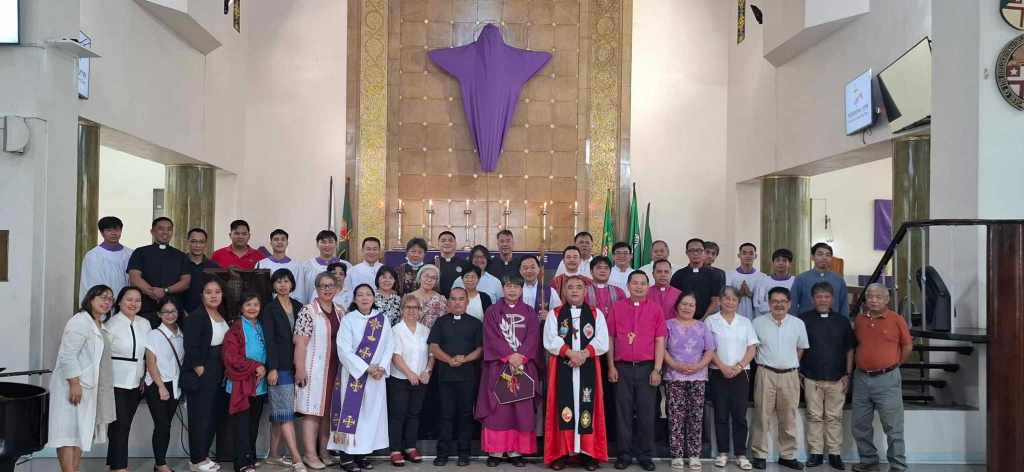
Welcome to the first Annual Corporation meeting of the Episcopal Church in the Philippines. You will recall that this was one of the amendments to our Constitution and Canons approved on final reading by our Provincial Synod last year. While this is in compliance with the Corporation Code of the Philippines, we realize that this annual meeting is indeed a great opportunity to listen and learn from each other and to map out our goals and ministries for the year. Again, since this is the first corporate meeting, we shall have a picture-taking immediately after the service to record this historical event.
Our Gospel passage this morning from Luke 4:1-13 was the Gospel lesson at our Sunday masses yesterday. I’m sure everyone has refreshed his and her understanding of this story and has done some personal reflections. It is about the temptation of our Lord Jesus Christ in the wilderness and how he dealt with it by citing, clinging to and living out Scriptures. It is a most appropriate reminder and guidance as we start the season of Lent.
Let me offer another lesson from the passage. When the devil tempted Jesus to turn stones into bread and to throw himself from the top of the temple into a drop of 450 feet below where he shall be carried by angels, Jesus did not do so and instead quoted Scriptures to explain why not. We can ask the question, why did Jesus not do these things if only to shut the devil up and to conclusively confirm that he was God, omnipotent or all-powerful? If he did, it would not actually be the first time that divine powers were compellingly displayed in response to a test and a challenge from a formidable adversary.
Recall that when Moses needed proof to show to Pharao that he was an emissary from God, God empowered him to turn his staff into a serpent and to turn water into blood. God also spectacularly parted the waters of the Red Sea so that the Israelites can pass through in their escape from Egypt. These were mighty and magnificent exhibitions of what God can do.
Yet, despite these spectacular display of divine powers for their benefit, the important question is: did the Israelites finally behave and live as God’s chosen people? Unfortunately, they did not. No sooner had they found themselves tasting freedom when they began complaining why they were not eating meat and questioning Moses why he led them out of Egypt to starve. When they found themselves freed from the shackles of slavery, they then turned and worshipped idols. Even when they stood at the threshold to the promised land, they rebelled and refused to enter, letting their fears and doubt take precedence over their trust in their liberator.
Jesus’ temptation in the wilderness happened at the start of his ministry and which immediately followed his baptism by John. As Biblical commentators point out, he was alone in the wilderness when the temptation happened so no other person can testify to it. Yet, it is one of those Biblical narratives detailed in all the Synoptic Gospels so Jesus must have told his disciples about it and made it a cornerstone lesson of how his mission and ministry shall be carried out.
From then on, when Jesus refused to turn stone into bread and to jump from the tower of the temple, he inaugurated the Kingdom of God that will be built not from the waving of the divine magic wand. It shall not happen by simply resorting to the exercise of supernatural powers. Again, that was done in the liberation of the Israelites from Egypt but it did not change peoples hearts and lives. It did not stop people from committing sin and disobeying God. From then on, the Kingdom of God shall be built out of peoples’ full and complete alignment of their lives to Christ. It shall take root in the hearts and lives of humanity, with the Holy Spirit pushing everyone up to God’s glory, as Jesus has done and taught. This is what the Church is called to continue to do.
We are now on the threshold of a leadership change in the Episcopal Church in the Philippines. Two days from now, the Rt. Rev. Nestor D. Poltic, Sr. will be installed as the 8th Prime Bishop of our Church. It is important at this point to take stock of where we are as we step on this threshold and to assess whether what we have done and are doing are in full alignment with God’s mission.
Allow me now to add to what had already been reported in the State of the Church address of the Prime Bishop at our Provincial Synod in May of last year as well as in previous meetings of Executive Council and in addition to what will be reported by the dioceses, institutions and organizations at this meeting.
A question was raised at the last Executive Council as to the financial impact of our thrust towards parish-hood particularly as a result of our past Vision 2018. As you know, Vision 2018 which called for the attainment by local congregations of full parish-hood was met with a lot of skepticism, if not outright resistance by more than a majority of our leaders and congregations. At that point, we were like the Israelites refusing to enter the promised land because of fears and doubts. Yet, this did not deter us from launching the Vision in January 2009 and building up the momentum of establishing parishes even after the end of the vision period in December 2018. As of December 2024, we have already established 98 full-fledge parishes in addition to the 32 parishes we built in 106 years from 1901 to 2008. The top performer is EDNP with 27 parishes built under Vision 2018, followed by EDNCP and EDSP tied at 17, then EDNL at 13 and EDS at 11. The lowest number of full parishes established from January 2009 to December 2024 is 5 for EDCP, even lower than the 6 parishes established by the newest regular diocese EDD. The Visayas Missionary Diocese, which was just established last year, has three full parishes, one organized mission and three preaching stations.
To give us an idea of what parish-hood means financially to the dioceses, our Finance Office computed that in 2024, a total of Php 27.054 million was saved by the dioceses because of full parish-hood. This was only for one year so you can imagine how much the dioceses have saved in the past 16 years since the launch of Vision 2018 and how much the dioceses will save in the future. These savings allowed the dioceses to enhance their capacities for mission work which explains the higher number of new work established and the intensification of ministries in various areas. Aside from the more important thrust of maturity of congregations in faith, parish-hood allows the Church to expand its ministries and as I often tell our parishes, your act of taking full responsibility for your operations have contributed to the opening of various works in the dioceses.
Last Saturday, March 8th, we signed a Covenant of Partnership between our Concordat Church, the Iglesia Filipina Independiente, the Iglesia UNIDA Ecumenical and the Episcopal Church in the Philippines, a document that the head of UNIDA, former Justice and now Bishop Rauol Victorino, says will outlive us all and prayerfully will still be alive and in effect up to the end times. Let me thank Executive Council for giving consent to the Prime Bishop to sign this document through a “flying” affirmative vote. I ask the Annual Corporation Meeting to confirm this consent.
It is a further great news that during the signing ceremony and celebration, our incoming Prime Bishop, Bishop Nestor, conferred with the General Secretary of the United Church of Christ in the Philippines, Bishop Joseph G. Agpoa who was invited to witness the signing of the IFI-IUE-ECP Covenant, and both expressed excitement towards a similar Covenant of Partnership between the UCCP and the ECP. Follow-up conversation in the dining table among us made this possibility not only very much welcome to both of our churches but in fact it may actually happen within the next two months, God willing. I ask the Annual Corporation Meeting for approval of this.
As I have mentioned in my message at last Saturday’s signing ceremony, the Covenant of Partnership should provide a home for every Filipino Episcopalian in places where he or she is a complete stranger. Our thrust in the long-term should be to make this possible in every nook and cranny of this country.
One day, retired police Colonel Ernesto Gaab came to the office to request for a sticker of the BSA, the Brotherhood of St. Andrew. He explained that he often travels along the Bontoc-Tabuk road where tribal communities along this stretch were notoriously known in the past to be hostile to strangers. But if you pass through this road now with a BSA sticker, tribal warriors would embrace you as a brother and would even invite you to a meal or coffee. Of course, this is because those tribal warriors are now members or friends of the BSA. That is what we want to experience in places in this country where we do not have a church but where our Covenant Church has a presence.
What I am emphasizing is that let us make the Covenant, just like our Concordat with the IFI, a living experience among our people in the level of communities, an experience where our people and those of other denominations with whom we have a Covenant can welcome each other and share their respective burdens and sorrows, their joys and achievements. I remember when we were in England for the Lambeth Conference and we were invited to the Sunday Mass at St. Barnabas Anglican Church. On that day, St. Barnabas was celebrating the 120th anniversary of the founding of the Iglesia Filipina Independiente, and I felt very sad that many people did not feel comfortable and were questioning why an Anglican congregation was celebrating the founding anniversary of a non-Anglican Church. But this is exactly what a Concordat and a Covenant should be. Again, it should be an opportunity for our people in the grassroots to worship together and to share and act on each other’s worries and hopes. This is what we must strive to make real in every congregation of our Church and let not our ecclesiastical protocols, parochial interests and even doctrinal differences frustrate our Lord Jesus Christ’s prayer that we may be all be one as He and the Father are one!
Let me share with this body that, at the celebration of 27th anniversary of the Concordat of Full Communion between the IFI and the ECP, our Concordat Church signed a Deed of Donation covering three parcels of land and 6 buildings in San Gabriel, La Union to the Episcopal Church. Let it be clarified that the three parcels of land and one building were actually owned solely by the IFI and only the five buildings were joint properties. We thank the IFI for this noble gesture of support to the mission of the ECP in the spirit of the Concordat. I promised Bishop Nestor that this will happen before I step down and so we thank God that He has made it possible for it to be realized. I ask this Annual Corporation Meeting to issue a Resolution of Acknowledgment and Gratitude in favor of the IFI.
To reciprocate this, we also signed last Saturday a Deed of Donation to the IFI covering our joint property in Alaminos City, as approved by our Executive Council in a previous meeting. This should now conclude, once and for all, the issue of joint properties which has been an irritant to our relationship for the past many years.
In 48 hours, I will finally be retiring after a total of 38 years in the ministry: 2 years as deacon, 20 years as priest, 13 years as diocesan bishop and three and a half years as Prime Bishop. I am happy and excited to retire because I will have all the time to be with my family, including my precious jewels, my 7 grandchildren. My excitement however also proceeds from the fact that I leave the Office of the Prime Bishop with the whole ECP in a very good position. To reiterate what I have often expressed in the past, we may be one of the very few churches and corporate entities that have stood firm and even significantly advanced financially, corporately and even in terms of mission in the aftermath of the covid-19 pandemic. This is because of the solid work that we have all done over the past many years.
I recall those difficult times in the 1990s when I was still a priest and our salaries were delayed for as long as 6 months. I recall those times when we had great plans and ideas but cannot do these because we did not have the corresponding budget. I recall those times when we cannot even build a single church for a long time.
I believe it is proper for the whole Church to now acknowledge and recognize that the sale of the portion of Cathedral Heights that unfortunately divided the ECP constituency at that time has been a game changer that has strengthened the foundations of our current financial stability. The proceeds of this sale is now one of our enduring capital funds, valued at Php 151.103 million as of end of 2024. Aside from helping stabilize church moneys during those times, the fund enabled us to establish several income generating projects that have provided and continue to provide a steady source of income to our dioceses. You will find the list of these projects in the report of the Treasurer. It was from this fund that we were able to acquire several parcels of land, a list of which is also in the Treasurer’s Report. One of these acquisitions is a major portion of the diocesan center of the Diocese of Santiago in Divisoria, Santiago City. Any Episcopalian visiting Santiago City can be very proud of this center now but prior to this, we were a nobody in that place. The great thing about the Capital Fund is that we did not spend the principal but actually loaned it out to the dioceses at a very low and affordable interest rate of only 4% per year. This why the income generating projects established from the fund were all successful because financial costs were minimal.
The portion of the Capital Fund that was not loaned out to the dioceses was invested in high yielding treasury bonds and at one time, trading of these bonds yielded a whopping Php 13 million pesos income. This is now part of the total Capital Fund and set up as Real Estate Fund with its income dedicated towards the acquisition of lands. That is why you will also find in the Treasurer’s Report a list of several parcels of land we purchased no longer as loans but paid for from the income of this Real Estate Fund. Two of these, the lot in Binan, Laguna where Holy Family Episcopal Church of EDCP is being built at a cost of Php 4 million and the lot in Lonoy, Capiz which has established our presence for the first time in the province of Capiz, were purchased three years ago. A third lot we purchased two years ago in Pagadian City now ends the barrenness of our mission work in the long stretch from Cotabato City to Zamboanga City. These three were our identified strategic areas from which we will launch our further expansion work.
As of December 2024, our Centennial Endowment Fund has grown to Php 257.82 million, with 75% of its annual income allocated to the dioceses. You will also find the details in the Treasurer’s Report but let me point out that the National Office’s management of this and our other capital funds has been exemplary and has allowed us to even grow in the aftermath of the pandemic.
Vision 2028 is proceeding slowly but surely. The reports of the dioceses last year have emphasized the intensification of activities towards our thrust to be a Scripture-rooted, Spirit-fired and Discipled Church. We celebrate the upsurge in Bible studies, the increasing number of our lay ministers as well as our people going for theological studies. But as we can see in our Gospel passage this morning, even the Devil quoted Scripture in his conversation with Jesus. And so we take note of the thrust of our dioceses not only to intensify proficiency in Scripture but more so to ensure that it is actually lived out by our people. We therefore hope to see in this year’s report actual stories of how our people have become more welcoming and compassionate to others, how we have gave light to workplaces by becoming models of anti-corruption and exhibiting modest Christian lives. As we are now in an election year, we hope to see our congregations and communities rejecting vote-buying and all the evil practices that are now the bane of electoral exercise in this country.
Finally, I want to take this opportunity to express my deepest gratitude to the staff of the National Office whom I had the greatest privilege to work with in the past more than three years. The sound fiscal management, the visionary staff support, the laughter and all the happy moments we have shared are treasures that I will always carry with me. I am sure you will also provide the same staff support to our incoming Prime Bishop.
In closing, we must indeed be thankful to God for all the blessings that He has bestowed and continue to bestow upon this Church. What we have accomplished were done primarily through our persistence in the guidance of the Holy Spirit and never on a hope and reliance on some magical formula or happening. Just like what our Lord Jesus Christ has taught us – that in facing challenges and difficulties, we just need to align our lives and work with His will and teachings. Amen.
+Brent H.W. Alawas
10 March 2025
 The Episcopal Church in the Philippines